


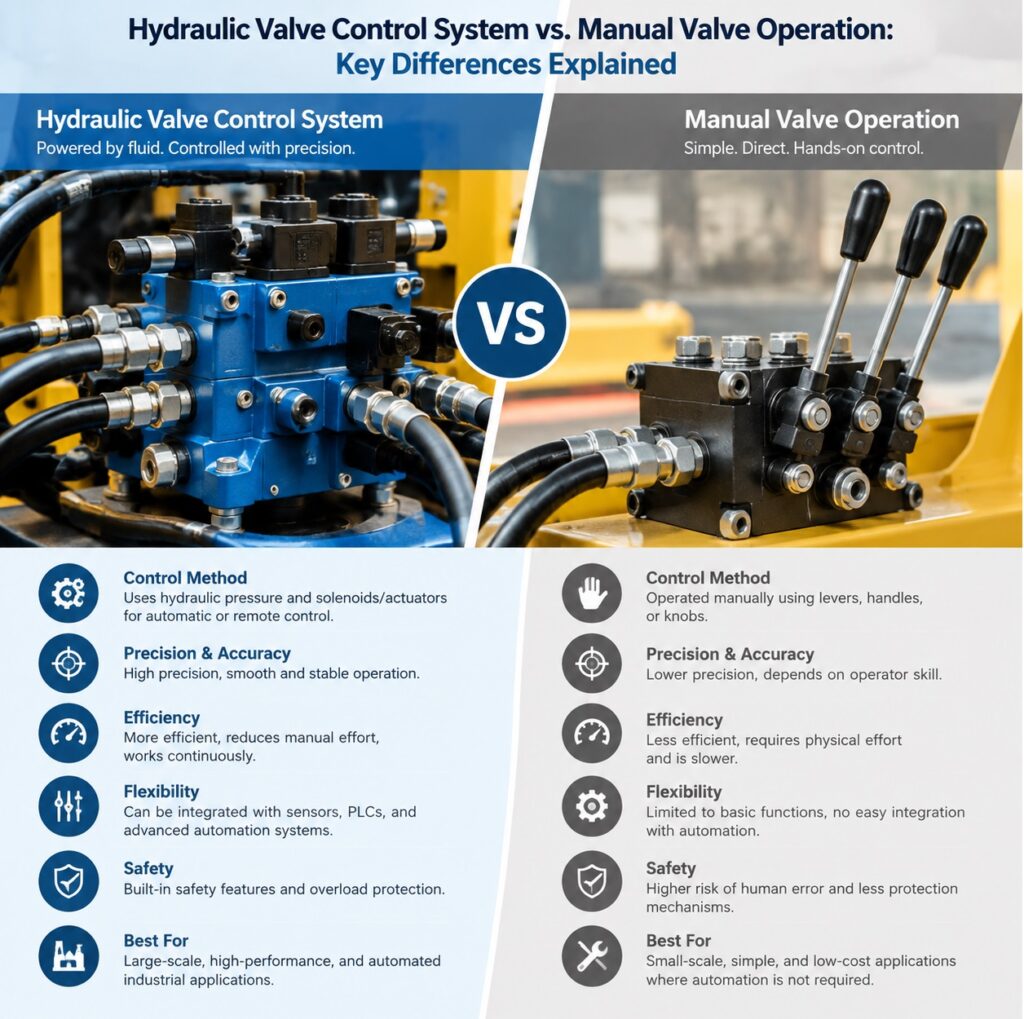








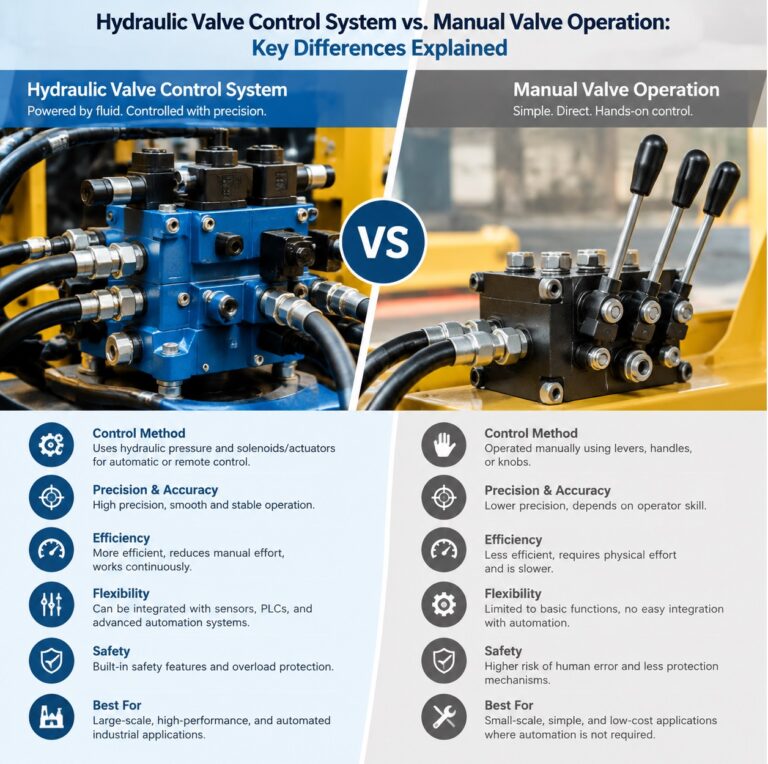




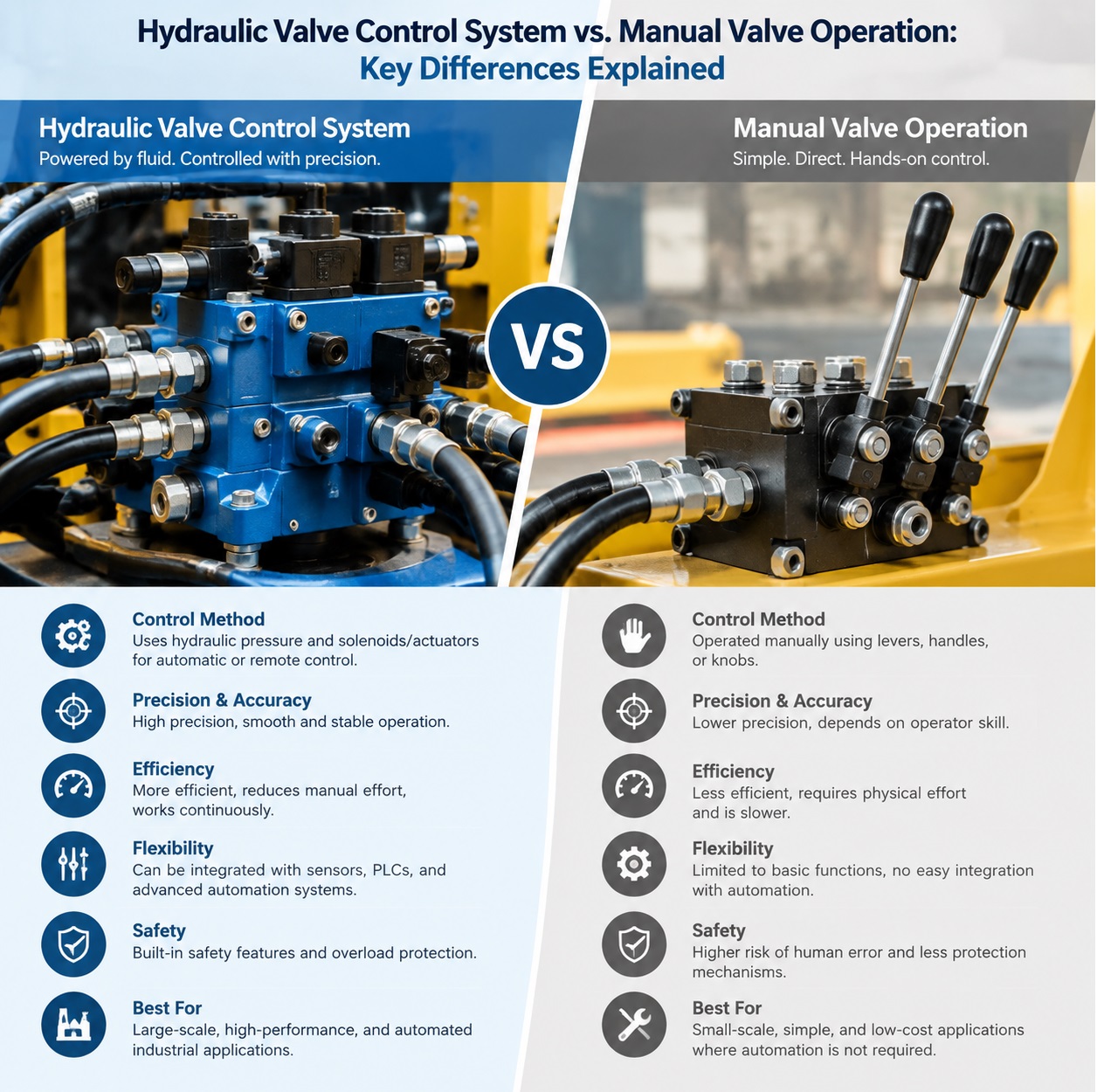
 A manual valve asks a human to be the control loop. A hydraulic valve control system removes that human from the hot, noisy, repetitive middle of the loop and replaces feel with feedback. That one change ripples through precision, speed, safety, labor, energy, and the true cost of every cycle. If you are comparing the two for a machine, a retrofit, or a full production line, here is what actually separates them.
Precision is where the gap shows up first. With manual operation, the operator watches a gauge, listens to the pump, and turns a handwheel until it looks right. That works until the oil warms up, the load shifts, or the operator gets tired. A hydraulic valve control system uses proportional or servo valves, sensors, and a controller to hold pressure, flow, or position within tight tolerances. It does not have a bad morning. It repeats the same ramp, the same dwell, and the same release thousands of times. For bending, pressing, injection, testing, or any process where scrap is expensive, that repeatability is not a luxury. It is the product.
Speed and response tell a similar story. A human hand can move a lever in a fraction of a second, but the decision to move it, the visual check, and the correction after the move take much longer. A control system reads a signal and adjusts a valve in milliseconds. On a high-cycle machine, that difference compounds into hundreds of extra parts per shift. On a complex machine with multiple actuators, it means smooth sequencing instead of operators running between stations. Manual operation can be fast in short bursts. Hydraulic valve control is fast in a rhythm that does not fade.
Safety is the difference that rarely makes it into the brochure until after an incident. Manual valve operation often puts people next to high-pressure lines, hot manifolds, moving rams, and heavy loads. The operator is the sensor, the controller, and sometimes the emergency stop. A hydraulic valve control system can move the human to a safe distance, enforce interlocks, limit pressure, ramp motion, and log faults. It can stop a sequence when a sensor disagrees. That does not make the machine harmless, but it reduces the number of ways a normal production day can turn into an injury report.
Consistency across shifts is another hidden cost. Manual operation depends on who is at the valve. One operator may ease the lever; another may snap it. One may compensate for a worn pump; another may not. The result is variation in cycle time, part quality, and tool wear. A hydraulic valve control system stores the recipe. The same parameters run on first shift, second shift, and the shift after a long weekend. When a process engineer wants to change a profile, they change it once in the controller, not in a training meeting.
Labor and skill requirements shift as well. Manual systems can be simple and repairable, but they demand experienced operators who can feel a problem before it becomes a failure. Those people are retiring, and the new hires may not have the same instinct. A control system does not eliminate the need for skilled maintenance, but it lowers the daily skill barrier. One operator can manage several stations. A maintenance tech can pull fault codes instead of guessing which valve is sticking. Training moves from tribal knowledge to documented sequences.
Integration is where hydraulic valve control systems leave manual operation behind. A manual valve is an island. It does not tell the PLC what it is doing, it does not report pressure drift, and it cannot be part of a production data stream. A controlled valve can talk to the machine controller, the SCADA system, and the maintenance dashboard. That data enables predictive maintenance, energy monitoring, and traceability. You can see when a valve is getting slow, when pressure is creeping, or when a cycle is drifting before it becomes downtime. In a market that rewards uptime, that visibility is a competitive tool.
Energy efficiency is not always the headline, but it often pays the bills. Manual throttling wastes energy as heat. The pump keeps pushing, the valve restricts, and the oil warms up. A hydraulic valve control system can match flow and pressure to the actual demand, use variable pump control, and reduce throttling losses. The savings depend on the duty cycle, but on machines that run multiple shifts, the kilowatts add up. The same control that improves precision can also cut the cooling load and extend oil life.
Then there is the money conversation. Manual valve operation wins on upfront cost. It is hard to beat a lever, a hose, and a gauge. But that low capex can hide high operating costs: slower cycles, more scrap, higher energy use, operator fatigue, and safety exposure. A hydraulic valve control system costs more to specify, install, and commission. It also tends to pay back through throughput, quality, uptime, and reduced labor variance. The right question is not which one is cheaper today. It is which one costs less per good part over the next five years.
Manual operation still has a place. If the machine runs occasionally, the process is simple, the loads are light, and there is no power or controls infrastructure, a manual valve can be the practical choice. It can also serve as a backup or override on a controlled system. The mistake is using manual operation by default on a machine that needs repeatability, speed, and data. That is not simplicity. That is deferred cost.
The smartest hydraulic designs often blend both. A control system handles the routine cycle, the precise motion, and the safety interlocks. A manual override handles setup, emergency recovery, and maintenance. The operator gets a safe way to jog the machine. The plant gets the repeatability of closed-loop control. That hybrid approach is not a compromise. It is good engineering.
So when you compare a hydraulic valve control system with manual valve operation, do not stop at the valve. Look at the whole circuit of cost. Precision, cycle time, safety, labor, energy, data, and uptime all change when you decide who or what turns the valve. A hand on a lever can be reliable. A control system can be relentless. For most competitive operations, relentless wins.