The Fentanyl Contamination Cleanup Process (What Actually Happens, Not the Brochure Version)
If your “cleanup plan” doesn’t obsess over documentation and control, it’s not a plan. It’s optimism.
Fentanyl isn’t the kind of contaminant that forgives sloppy boundaries, casual PPE use, or vague “we wiped it down” assurances. The real process is methodical, sometimes annoying, and absolutely built around one idea: prove it’s safe, don’t just hope it is.
One-line truth: The hardest part isn’t cleaning. It’s demonstrating you cleaned enough.
Scene Assessment: the first 20 minutes set the tone
When a team arrives, you’re not there to play detective. You’re there to prevent exposure, fast, and to stop the scene from getting worse through movement, airflow, and well-meaning chaos. In situations involving suspected drug contamination, that often means calling in professional meth lab cleanup services before anyone turns a bad scene into a bigger one.
A good assessment has two gears:
– Rapid hazard check (what can hurt people right now?)
– Structured mapping (what could spread, where, and how?)
You look at ventilation status, likely pathways of contamination, and human behavior risks (people love to wander). You flag entry/exit routes. You note porous materials. You document what you see without inventing a story about it.
And yes, you write it down immediately. Time stamps. Photos. Notes that would still make sense to someone reading them six months later during an audit or a lawsuit.
Now, this won’t apply to everyone, but… if you can’t explain your initial perimeter choice in one calm sentence, your perimeter is probably wrong.
What you’re really identifying: vectors, not just “dirty spots”
Here’s the thing: fentanyl events aren’t only about visible residue. Transfer is the enemy. Touch points. Soft goods. HVAC returns. The floor outside the room because someone stepped there while doffing gloves wrong (I’ve seen it more than once).
So the contamination “risks” you document should read like a ranked list of how exposure could happen:
– direct contact with residue
– transfer via gloves/clothing/tools
– resuspension as dust from disturbed surfaces
– tracking contamination out through foot traffic
– airflow carrying particulates toward clean zones
Each risk entry should have location + observed condition + confidence level. Avoid heroic certainty. “Possible residue on nightstand, photographed, pending swab” is better than “nightstand contaminated” when you haven’t tested it.
Containment & Isolation (a.k.a. stop making it worse)
Containment is half engineering and half discipline.
The engineering is barriers, signage, floor protection, controlled entry points. The discipline is access control, logs, and a process that people actually follow under stress.
Sometimes I explain it like this to non-technical folks: you’re building a small, temporary “cleanroom mindset” in a very unclean situation.
Practical containment moves that actually work
– Establish hot / warm / cold zones with clear boundaries and visible markings
– Restrict entry to essential personnel (no spectators, no extra “helpers”)
– Use a single controlled entry/exit if you can manage it
– Lay down non-porous floor covering where tracking is likely
– Maintain an entry log (who, when, why, PPE level)
And yes, you check your barriers repeatedly. Tape fails. Doors get propped. People “just step in for a second.” That’s how small incidents become building-wide headaches.
Removing contaminated materials: boring, meticulous, non-negotiable
Material removal is where teams get overconfident. They shouldn’t.
You don’t yank everything out at once. You sequence removals to limit cross-contact. You categorize waste streams. You package and label with the same seriousness you’d use for evidence, because sometimes it is evidence, and because you may need to prove exactly what left the site and when.
You also track chain of custody where applicable. Not because it’s fun paperwork, but because confusion later is expensive.
In my experience, the most common failure here is mixing waste types (soft goods, debris, sharps, general trash) because it “all looks contaminated anyway.” That’s lazy and it can create disposal and compliance problems you didn’t need.
Decon: surfaces first, then air (and don’t aerosolize your problem)
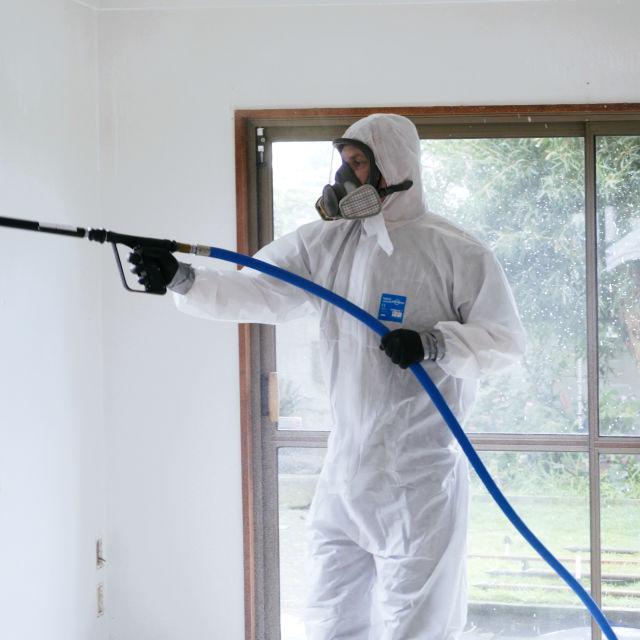
Decontamination isn’t “spray and pray.” It’s controlled removal, with methods designed to avoid making particles airborne.
Sequence matters. Technique matters. Contact time matters. And the materials you’re cleaning matter, too, porous and semi-porous surfaces can be a different animal entirely.
Look, if you’re dry sweeping or using aggressive agitation on suspect residue, you’re not cleaning. You’re redistributing.
A typical approach:
- Remove visible contamination using premoistened disposable wipes or controlled HEPA vacuuming when appropriate
- Apply validated cleaning agents with correct dwell/contact times
- Work from high-risk touchpoints outward (handles, switches, counters, work surfaces)
- Manage airflow intentionally (portable HEPA air scrubbers as needed; don’t create turbulence for no reason)
- Document the what/where/how: agent, dilution, surfaces, time, personnel
One short paragraph, because it deserves one: PPE donning/doffing errors ruin good decon.
Verification testing: the part people want to skip
Everyone loves “done.” No one loves “prove it.” But verification is where the cleanup either becomes defensible or becomes a handshake agreement.
You do repeat sampling, surface and, when indicated, air, based on a plan that makes sense for the site layout and likely exposure patterns. High-contact surfaces aren’t optional. Breathing-zone considerations aren’t optional either.
Lab work needs to be real lab work: validated methods, known detection limits, and reporting that includes uncertainty. If the lab can’t tell you sensitivity and QC basics, find another lab.
A specific data point (because hand-waving gets people hurt): NIOSH has warned that illicitly manufactured fentanyl and analogs can pose occupational exposure risks, and emphasizes controls such as PPE, hygiene, and avoiding aerosol-generating actions. Source: NIOSH/CDC, Fentanyl: Preventing Occupational Exposure to Emergency Responders (NIOSH topic guidance).
Does that give you a universal numeric “safe level” for every surface in every building? No. But it does reinforce the principle: control exposure pathways and validate outcomes with credible methods.
If results come back above the action threshold you’re using, you re-clean and re-test. No drama. Just process.
Clearance and reoccupancy: where science meets liability
Clearance isn’t a vibe. It’s a package.
Sometimes this part reads like a specialist briefing because it is one: you compile sampling plans, results, calibration records, training documentation, waste manifests, photographs, chain-of-custody forms, deviation logs, corrective actions, and final sign-offs.
Independent verification, when done correctly, adds real trust. I’m a fan of it in any situation with public concern, tenant turnover, a workplace exposure claim, or reputational risk. Even when the cleanup is solid, an outside reviewer keeps everyone honest.
And yes, legal compliance lives here too. Disposal rules, worker protection requirements, reporting obligations, site-specific regulations. The details vary by jurisdiction, but the principle doesn’t: if you can’t defend your clearance decision on paper, you don’t have clearance.
After the “all clear”: ongoing vigilance (the unglamorous part)
Some spaces don’t need much after clearance besides normal hygiene. Others do. It depends on the incident, the building, and how confident you are in the boundaries you maintained.
Post-cleanup monitoring, when warranted, usually focuses on:
– periodic wipe sampling at selected high-contact points
– HVAC/ventilation checks and filter handling practices
– refresher training for staff who work in the space
– a clear response plan if new residue is found or suspected
And you communicate plainly with occupants. Not alarmist. Not vague. Direct: what was done, what was tested, what passed, what to do if something seems off.
One last opinion, since I’ve earned it: the best fentanyl cleanup teams aren’t the ones with the most gear. They’re the ones who refuse to get casual.